

Let’s be blunt: diners rarely remember the wine fridge, unless it’s unforgettable. You’ve spent months crafting a wine list that reads like a dream. Why bury that under a foggy door and weak lighting like it’s the clearance section at a gas station? Your fridge is the red carpet your wines walk down.
Here’s what truly catches the eye:
- Glass clarity and lighting: Low-iron, anti-UV glass with dimmable LED lighting avoids both foggy displays and light damage to wines. Opt for warm spectrum LEDs (2700K-3000K) to mimic soft candlelight rather than harsh supermarket brightness. LEDs should output less than 1.5W per shelf to avoid thermal interference. (Think more “Michelin-star mood lighting,” less “airport terminal.”)
- Framing materials: Black stainless steel says “modern restraint”; brushed brass leans vintage-luxury. Want something to blend in with dark wood panels? Look for customizable trim kits that can be finished in walnut, oak, or matte black aluminium. Ideal panel thickness: ¾” to ensure flush fit with cabinetry. Frank Lloyd Wright would’ve approved.
- Label-forward racks: You’re trying to curate wine. Horizontal racks angled at 15° show off both vintage and varietal while preventing cork drying and label smudging from condensation. Wire racks should be powder-coated to avoid rusting; wood racks should use kiln-dried hardwood to prevent warping. Picture this: a lineup of Domaine Leflaive Puligny-Montrachet, lit just right, labels whispering luxury. That’s what we’re aiming for.
Where to buy?
We recommend EWS Commercial Wine Fridges, which are built specifically for commercial settings – including slim models to fit tight layouts and large display cabinets. They also include humidity and vibration control that actually protects your wine. The clean, modular design looks great front-of-house, and their support team understands hospitality, with service that shows up when you need it.
The Teca TV10 Wine Wall below is a great example:
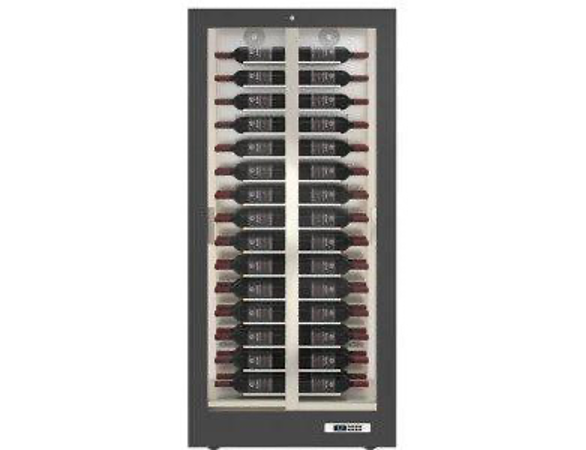
Quick visual trigger: Think of the difference between a wine fridge that disappears into the back wall versus one that makes a Bordeaux flight look like a tasting-room sculpture. One invites engagement, the other blends into oblivion.
Takeaway: If the fridge doesn’t make guests ask, “What’s in there?”-it’s not doing its job.
Capacity Without Clutter: Match Bottle Count to Flow, Not Ego
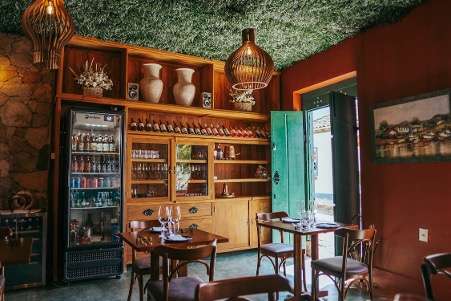
Let’s kill the myth: Bigger is not always better-especially behind the bar. This isn’t your uncle’s basement man cave. Your fridge needs to serve your flow, not your fantasy of a 1,000-bottle walk-in.
Rule of Thumb for Service Zones:
- By-the-glass wine bars: 50–75 bottles max, spread across dual zones.
- Full-service restaurants: 100–150 bottles, ideally with overflow nearby.
- Fine dining spots: Up to 300 bottles in decorative units-plus back-of-house cellaring for long-term holds.
Expert tip: Pay attention to air circulation between bottles. Overstuffed fridges lead to hotspots (source). Look for models with internal carbon filters and multi-directional airflow fans. Imagine cramming 140 bottles into a 120-bottle fridge, and your lower corner bottles are served at 68°F in mid-summer. Not ideal for a premium Barolo. Recommended bottle spacing: at least 0.5″ between shoulders for optimal airflow.
If a bottle feels warmer than your hand-Houston, you have a problem.
Service-ready fridges don’t just store wine-they reduce friction during peak hours. Prioritize circulation as much as capacity.
Zone In: Single-Zone Looks Good-Dual-Zone Works Better
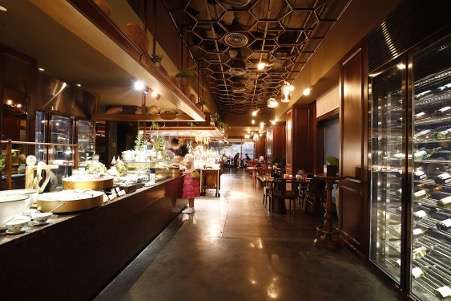
Here’s the quiet truth your waitstaff won’t say out loud: nobody likes “hurry-up-and-chill” wine service. That’s the Champagne on ice five minutes before a pour. Don’t make your guests wait-or worse, compromise.
Your working options:
- Single zone: Best for wine bars with narrow menus (e.g., all-natural reds). Simple, clean, budget friendly. Typically maintains 53–57°F across full interior (source).
- Dual-zone: Handles both cellar-temp reds (58–64°F) and crisp whites (42–50°F) with no extra handling. Perfect for dynamic menus.
- Triple-zone or multi-compartment: For tasting flights or premium menus where sparkling, whites, and reds rotate frequently. Look for zones with independent thermostats and active cooling modules per compartment. Ideal variance: no more than ±1°F per zone.
Insider tactic: Picture a bistro in Portland saving 15 minutes per shift by switching to a dual-zone model, eliminating manual icing. That frees their barback for more profitable tasks, like upselling by-the-glass. Multiply that over 5 shifts a week and your wine fridge just paid for itself in four months.
Never underestimate how much a poorly chilled Sauvignon Blanc can cost you in repeat visits. Cool wine = faster service = more table turns.
Silent Operators: Why Noise and Vibration Kill the Mood (and the Wine)

Imagine a quiet date night. Candlelight. Acoustic jazz. A special occasion pour. And then-BZZZZZZZT-your fridge hums louder than a blender. That’s not background noise. That’s a dealbreaker.
What to look for:
- Compressor-mounted rubber dampers (minimizes rumble and humming)
- Low dBA rating (under 40 dBA ideally). For comparison: 35 dBA = whisper quiet, 50 dBA = light rainfall (source).
- Active vs passive cooling: Active systems cycle faster but louder; passive systems are quieter but slower to respond
- Thermoelectric options: Super quiet (<30 dBA) for small service zones, though limited in power for high-traffic or large capacity needs
In hospitality, “quiet” is a feature, not a bonus. Protect both the wine and the experience.
Front Venting or Rear? Don’t Let Design Trip Up Function

It’s a classic rookie error: You find a gorgeous fridge. You install it snug under the counter. It overheats on Friday night. Why? Rear vent. Zero airflow. Dead unit.
Golden rule: For built-in or undercounter use, choose front-vented units only.
Rear-vented models are great for freestanding displays where air can circulate freely.
Also, check your clearance:
- Minimum of 0.5–1″ around sides and top
- 2–3″ behind for rear-venting units (if absolutely necessary)
- Level floors only-compressors hate tilted footing. Misaligned levelling screws can throw off internal airflow too.
Compressor angle tolerance is typically ±2°, beyond which performance drops.
An overheated fridge on Friday night is one thing. A melted bottle of Champagne? That’s a review waiting to happen.
Showcase by Season: Lighting and Racking as Strategic Sales Tools
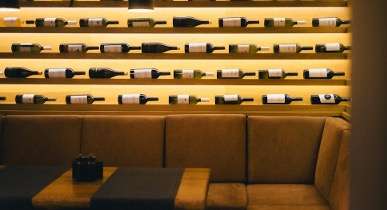
Your fridge isn’t just a box-it’s a stage. Light is the spotlight. Racks are the choreography. If your fridge doesn’t help you sell what’s inside, it’s underperforming.
How to boost visibility and engagement:
- Adjustable LED lighting to highlight seasonal rotations (autumn burgundy tones, summer rosés). Look for CRI (Colour Rendering Index) of 90+ for accurate label display.
- Label-forward racking for easy readability-especially in low lighting. Racks should support 750mL and magnum sizes interchangeably.
- Eye-level placements for your highest-margin wines
- Slight angling of premium bottles (5–10°) to create depth and shadow, giving them a spotlighted appearance
Your fridge layout should drive curiosity-and sales.
Know Your Glass: What Guests See vs What UV Sees

Glass is a paradox-it lets people see in, but also lets harmful rays sneak through (source). That Sancerre in the spotlight? Without protection, it’s slowly getting cooked.
Glass features worth paying for:
- Low-E (low emissivity) glass: Filters UV while maximizing visibility. Aim for UV filtration ≥95%.
- Tinted or mirrored panels: Offer a glam look while shielding labels and wine. Tint strength: 20–30% is ideal for restaurant lighting.
- Double or triple glazing: Helps maintain consistent internal temps, especially in high-traffic kitchens. Triple-pane offers R-value of ~5.8 compared to ~3.0 for double-pane.
- Gas-filled gaps (argon or krypton): Added insulation layer that prevents fogging and sweating
If you’ve got a south-facing bar with direct sun-this isn’t a maybe. It’s non-negotiable. UVA and UVB don’t care about your décor.
If your bottles are sunbathing all day, expect complaints before you see them coming. Control the light, preserve the value.
Branding Bonus: When Custom Finishes Become Part of Your Story

You’ve got reclaimed wood walls, Edison bulbs, and monogrammed coasters. But your wine fridge screams “big-box appliance store.” Disconnect? Totally.
Look for fridges with:
- Customizable panel kits (woodgrain, matte black, copper accents). Typical customization lead time: 3–5 weeks.
- Logo etching options on glass doors. Frosted vinyl or laser-etched; branding area max: ~4″ x 6″.
- Backlighting colour customization for mood setting (warm amber = rustic comfort; crisp white = modern sophistication)
- Modular shelving systems that let you rotate orientations based on current promotions. Look for shelf loading capacity of 25–35 lbs.
When a fridge becomes a conversation piece, it earns its real estate.
Final Step: Get Staff Buy-In Before the First Bottle

The fridge isn’t just for flair-it’s a frontline sales tool. But here’s the rub: If your staff doesn’t know how to use it, it’s just expensive furniture.
Checklist before going live:
- Conduct a 15-minute “fridge orientation” during staff meeting
- Set a visible weekly restocking calendar
- Assign a point-person for fridge maintenance and guest questions
- Include visuals of fridge layout in the training binder
- Train servers to refer to the fridge when recommending: “You’ll see that Riesling on the second shelf-it’s brilliant with our scallops.”
Want an easy script? “That bottle right there was hand-picked for the chef’s menu this week.” Boom. Now your wine fridge is doing half the talking.
This article was contributed by an expert reader.


